

This article includes the following parts:
Manufacturing Priorities According to Due Dates
Usually, the manufacturers manufacture to order. That means that each work order on the shop floor is for a specific customer for a given due date. In TOC, we have a specific way to prioritize all of the orders that exist in the system.
In any environment, it is a must to be able to maintain close to 100% reliability of the orders. To achieve such reliability we have to be able to quote safe due-dates that are reasonable to the customers while taking the capacity of the CCR (Capacity-Constraint Resource) into account.
S-DBR (The prioritization mechanism on the shop floor) and the Planned Load (Onebeat way of handling CCRs (potential internal constraint) are Inherent Simplicity solution for that.
For a grand understanding of the production solution see "Using SDBR in Rapid Response Projects" by Eli Schragenheim. This article is meant for the RRR solution, but most of it applies to any production environment.
Time Buffers
The logic of TOC defines a safety element and constantly monitors how the safety element is being used. This safety element is called a buffer. In production for orders to a client (as oppose to production for stock), the buffer is a time buffer.
The production time is not constant, hence the need for a protection. The production time is made out of touch time and queue time. The touch time is usually a small fraction of the production time, most of the time is wasted on queues.
The buffer is a variable that is subjected to the users decision. It represents the time frame that is given to accomplish producing the order in very high chances not to be late. The initial buffers are recommended to be half of the lead time.
See Example
We are a furniture factory. The touch time for chairs is 10 hours, and the standard lead time is 15 days. The buffer for chairs is defined to be 7 days.
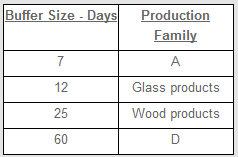
The buffers are set to the products according to Production Families.
See Example
BP & The Prioritization Mechanism
Release method
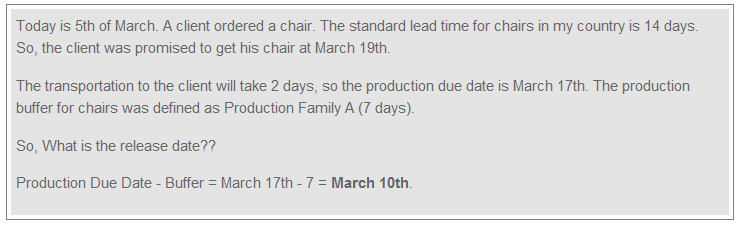
The buffer is the time needed for producing a given order, meaning that the material release should be executed a buffer before the due date.
See Example
BP & The Prioritization Mechanism
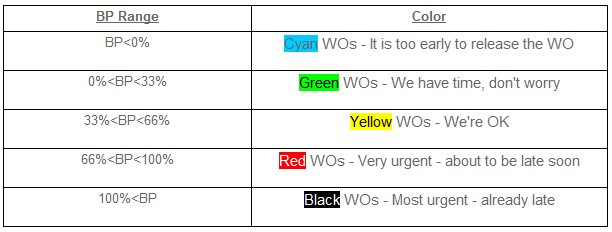
The main prioritization mechanism is done by color.
Black WOs - Most urgent - already late.
Red WOs - Very urgent - about to be late soon.
Yellow WOs - We're OK.
Green WOs - We have time, don't worry.
Cyan WOs - We are moving too fast. This WO shouldn't be processed yet.
The second optional prioritization mechanism within the colors, is done by Buffer Penetration (or "BP"). The BP also determines the color of the order.
BP, or buffer penetration, is a percentage that represents the WO's (Work Order, or just Order) urgency.
The BP is defined in a way that the order should be released in 0% BP, and when the due date arrives the BP is 100%.

Where usually:
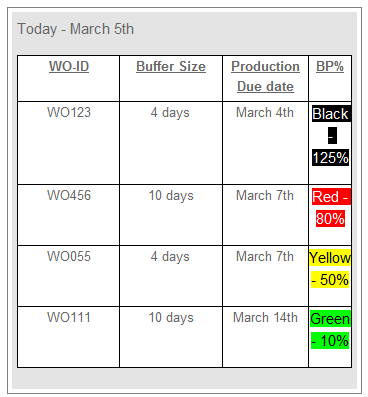
To conclude, the prioritization will be in the following way - The higher the BP is, the more urgent the order is.
See Example
Comments
0 comments
Please sign in to leave a comment.