

Overview
Our experience shows us that terms like "average consumption" are not practical for real-time decisions, those terms can assist us to ease some calculations and to simplify our models. In real life we deal with everyday variation in consumption, that consumption might be statistically stable (constant distribution function) though usually has some level of fluctuation.
In the common case, DBM perfectly deals with these fluctuations in consumption, but as expected, this ability is limited to reasonable fluctuations only. Seasonality is a complementary mechanism to the DBM and relevant in cases where we know in advance that by using DBM we will not be fast enough to cope with the change.
See seasons examples
The SDC (Sharp Demand Change) most common case is due to a seasonal consumption. That's where the name "Seasonality" initially came from.
In Onebeat we define "Seasonality events" as events of either increasing or decreasing the buffer size of an SKU as desired to adjust for a season.
A Seasonality event example
Supposing that the following Graph describes our sales pattern during a season:
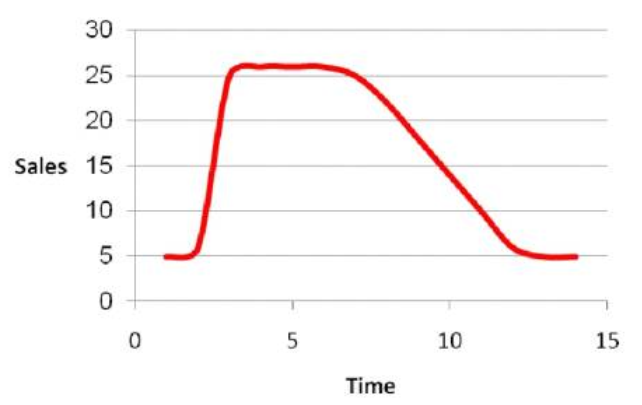
If translating the graph into words, we start with a sharp increase in sales, then a constant (probably with some level of fluctuations) consumption rate during the season, and finally the consumption rate decreases slowly to its original state.
That pattern requires one or two Seasonality events:
- Buffer increase - should take place enough time before the season starts, so we'll have time to replenish and build the buffer. That increase can either be a one time change or gradual but should end before the season starts*.
- Buffer decrease (optional) - it depends on the decrease in sales rate, it might be that we should gradually decrease the buffer with a Seasonality event or we might as well let it be decreased gradually by accepting Too Much Green recommendations.
*After the first Seasonality event ends, the DBM is in place again, searching for either TMR or TMG.
Comments
0 comments
Please sign in to leave a comment.